So I've read quite a bit about the unfortunate but probable shutdown this week. I felt like writing up a brief analysis and explanation at what the sides are disagreeing about. I'm tagging this as "Politics-neutral" meaning I will not be offering an opinion one way or the other.
Note: I'm publishing this even though my website isn't "finished" so while I'd like to have a table of contents, comments, etc. those are not yet in place.
Cheesy unlinked table of contents:
-
Simplified reason why shutdowns happen
-
Primary issues the Democrats want
-
Negotiations
-
Brief look at Republican claims
-
History of shutdowns
Simplified reason why shutdowns happen:
Without going in to too much detail normally any bills to be passed to the President need to have a majority in the House and 60 votes in the Senate to avoid a filibuster. The spending bill passed in July for 2025 used a reconciliation process and was able to be passed with a simple Senate majority (51-50 with Vance as the tie breaking vote).
Now the last time either party had 60 Senators in the Senate was in 2008 under Obama. Since then any bill from one party generally needs a few members of the other party to pass. That's the situation this spending bill is in. The Republicans only have 53 votes and need at least 7 Democrats to vote in favor of the bill to pass it.
Primary issues the Democrats have that may lead to a shutdown
There seem to be 3 primary issues that the Democrats would like addressed with the first being an immediate priority.
-
The American Care Act a.k.a. Obamacare Premium Tax Credit which expires at the end of this year
-
Cuts made to Medicaid by the so called "Big Beautiful Bill" which will take place in 2027
-
Stopping the practice of Recissions and restoring funding to the corporation of public broadcasting which was removed this year
#1 - Premium Tax Credit expiration The Premium Tax Credit portion of the American Care Act (Obamacare) will expire at the end of 2025. In the 2025 plan year there are 24 million people enrolled in the ACA with 422,000 in Utah 1
So health insurance companies have long followed the practice of setting prices based on the number of people enrolled. So for example a small employer will have an overall higher cost per person for insurance for a large employer. 2 The theory here is you want more healthy people enrolled to cover the extra costs associated with the sick people. The same thing applies to the healthcare.gov insurance marketplace. If fewer people enroll then the insurance companies will have to raise the rates since the sick people are more likely to enroll than healthy people if the cost is too expensive. As a result overall health insurance rates at the marketplace will increase around 20%.
There are many lower income people who use the marketplace and the credits help them obtain insurance. If the credits expire then many (most?) of these people will not be able to afford insurance anymore and will just go without.
This is an urgent issue for the Democrats and people on the ACA because open enrollment for the ACA is set to start November 1st. If the Premium tax credit is not in place at that point then all prices on healthcare.gov will reflect the full price even for the low income earners leading to many not enrolling. Even if they renew the premium tax credit at a later point the damage may already be done.
#2 - Medicaid Cuts made in the spending bill passed July 2025
In July 2025 President Trump signed the 2025 spending bill in to law which he called "The Big Beautiful Bill." In the bill was a one trillion dollar cut to Medicaid, most of which will take effect in 2027. The Congressional Budget Office estimates that this will report in 7.8 million people in losing their Medicaid coverage. 3
There is also concern about how the Medicaid cuts will affect rural hospitals. They will lose an estimated $50 to $70 billion in funding. To counter this Republicans added a $50 billion "Rural Health Transformation Program." The funding is sent to States and all programs must have approval from Dr. Mehmet Oz who has wide discretion as to how the funds are spent. Many people are concerned that this may lead to funds only going to certain states or that non Rural programs can receive funds. 4
#3 - Reversing Recissions made in 2025 and stopping the practice
In July 2025 the Recissions Act of 2025 was passed. If I understand this right the Whitehouse can request recissions of certain expenditures which have previously been approved. The House and Senate then have 45 days to pass them by a simple majority or they will be reversed. This resulted in the complete defunding of the Corporation of Public Broadcasting (CPB) and cuts to USAID. In 2025 about 64% of the CPB went to local television and radio stations, 18% to television programming (Sesame St., etc), with only 1.8% or $9.58 million going towards the Radio Program Fund (National Public Radio).
Some television stations get about 50% of their budget from the CPB so the funding cuts could result in many limiting programming or going off the air. Even though it is 2025 there are still rural areas that rely on their local stations as the primary means of communication such as Indian Reservations, stations in Alaska, etc. As a result one of the Republican Senators in Maine and one in Alaska joined all of the Democrats in voting against the recission package.
Negotiations
Democrat leaders Schumer and Jeffries report that they have been trying to have negotiations for several weeks. They had a meeting scheduled as of September 24th with President Trump which was later cancelled. 5. Democrats and Republicans did meet on September 29th but that did not lead to a compromise.
Note: I will update this post should they meet again on September 30th.
What some Republicans are saying:
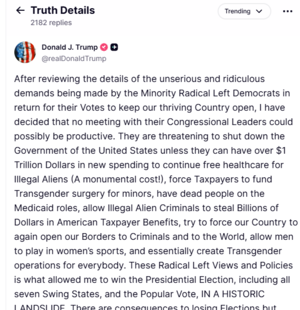
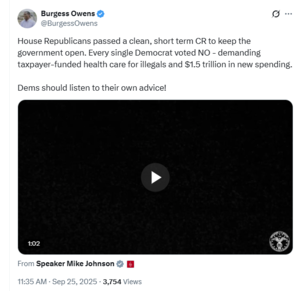
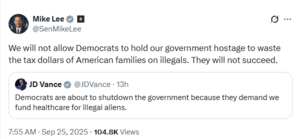
There seem to be a couple of talking points that I've seen from Republicans I know to be among the far right wing on the political spectrum.6 7 8 A couple of claims that might be inaccurate are the following:
- References to "New" Spending. I have found it difficult to define "new" spending. This claim may be technically correct. With that said all of the Democrat spending demands were removed by Republican simple majority votes in July 2025 so calling them "new" may be misleading.
- References to spending for undocumented (illegal) immigrants. It is not legal for federal Medicaid funds to be used on undocumented immigrants. This is not a demand and it is not part of the negotiations. This seems to refer to some states who use their own state tax funding to augment Medicaid programs and allow undocumented immigrants to receive health care. This is purely state funding which has nothing to do with the Medicaid cuts made so this is false.
- References to National Public Radio. I have seen some Republican objections to restoring funding to the "liberal" NPR. This is of course true but as discussed above this is less than 2% of the funding previously cut for the Corporation for Public Broadcasting.
Brief comments on recent government shutdowns:
-
2024 Biden: While the government did not officially shut down in 2024 it was very close. There was a last minute compromise made which allowed it to stay open.
-
2018 Trump 35 days: The primary contention was the inclusion of funding for the Boarder wall which Democrats objected to. Schumer reported that he offered a compromise with Trump to allow full funding for the border wall ($20 billion) in exchange for Trump not trying to deport the so called DACA Children who are undocumented immigrants who have been in the U.S. since they were very young, many of which have no memories of ever living in another country. Schumer and Trump never reached an agreement. Air Traffic Controllers are among the federal employees deemed essential who were working without pay. The shutdown ended when 10 Air Traffic Controllers in charge of specific high qualification areas stayed home. This cause chaos in many large areas and led Trump to sign the bill without border wall funding.
-
2018 Trump 2 days: In January 2018 the government was shutdown for two days and it shutdown in Feb and Mar for several hours each. In the end the issues were pushed forward to be dealt with later.
-
2013 Obama 16 days: There was a Republican majority in the House and a Democrat majority in the Senate. The issues were the Repupublicans wished to delay the start of the Affordable Care Act and the Democrats whished to raise the debt ceiling.
- Marketplace Enrollment, 2014-2025 | KFF State Health Facts ↩︎
- Note that this is overall cost, the cost the employees pay depends on how much the company wants to pas and how much they pass on. ↩︎
- https://www.cbo.gov/publication/61510 ↩︎
- https://www.healthaffairs.org/content/forefront/one-big-beautiful-bill-now-law-does-not-protect-rural-hospitals ↩︎
- Truth Social ↩︎
- Truth Social ↩︎
- https://x.com/BurgessOwens/status/1971267230932533500 ↩︎
- https://x.com/SenMikeLee/status/1971211865473810528 ↩︎